
Why do we see movies? Because very rarely, a certain story will come along and spill sudden, spectacular color into the dried-out palette of our perception, or take the shape of a fear we abhor, a desire we cherish, and reveal that it is far less significant than imagined. Like a child finding an imposing shadow to be cast by a wonderfully mundane plaything.
Yet, disappointingly, many films fail to deliver simply because their endings lack. And it’s no surprise — the ending of a story is the hardest part to write. When an ending is great, we learn from it and carry the lesson with us into life. When an ending is poor, or underbaked — take, for instance, an overused message executed lukewarmly — it’s like getting to the top of a roller coaster just to find out you’re two feet off the ground. In this series, kicking off with “The Conjuring: Last Rites”’s tragedy of a conclusion, I attempt to isolate bad endings and alter them to better suit whatever meaning a movie set out to say all along.
Sentient dolls, psychic readings, gorgeous cobwebbed Victorians, and otherworldly evil — the allure of “The Conjuring” lie in its modern reminiscence on vintage horror. For a franchise to thrive so long, something of true substance must be present. That “something” is the cinematic expertise with which “The Conjuring” convinces you that you are there, observing the dusty floorboards of an antique rural home nestled in some backwoods, and standing on the unmarked grave of the restless dead. As I watched the first of the four films almost two years ago, it became quickly apparent just how much atmosphere is prioritized: the beaded ruby lampshades collect dust; time period accuracy is prevalently convincing; the tension is as real as though the ghost itself were beside you.
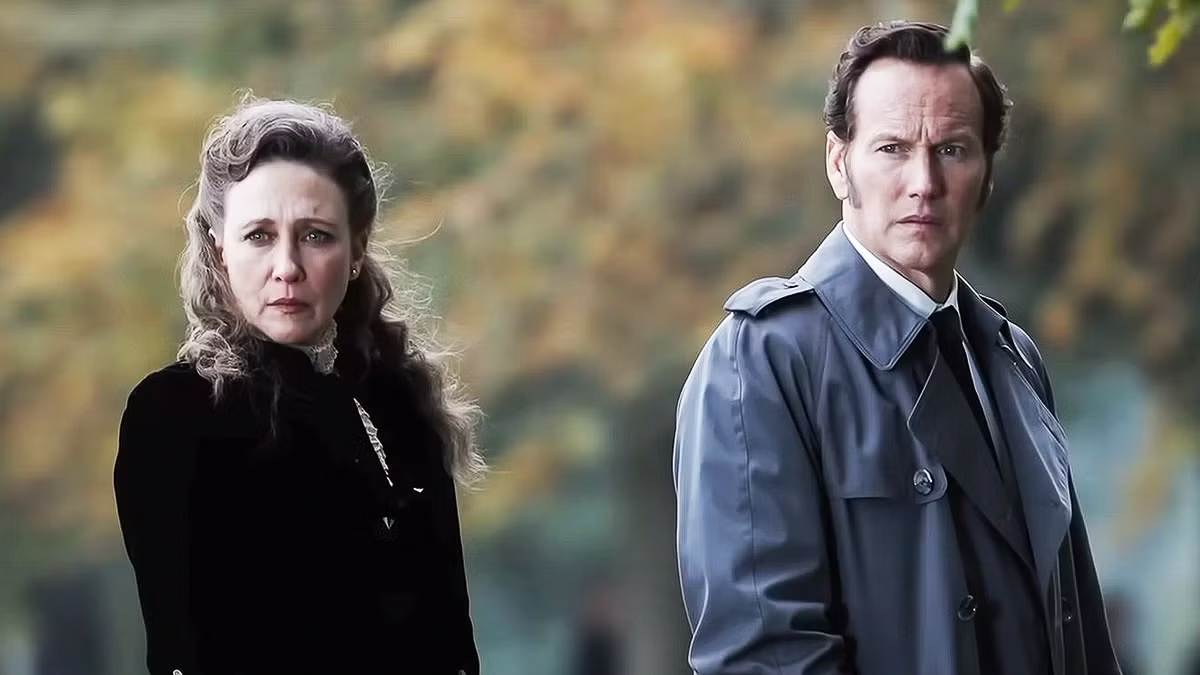
“The Conjuring” series primarily focuses on the Warrens, a devoted couple who have spent their days encountering poltergeists, demons and the families they torment. Lorraine Warren, a paranormal investigator, experiences clairvoyance, a gift and a curse, which allows her to see the lingering tragedies attached to haunted locations. Alongside her husband Ed, a seasoned Demonologist, they unravel the buried history of menaced homes, and from there, begin their services as ghost-hunters. By the finale of every film, they emerge having banished — or at least postponed — a lasting dark presence which seeks its way to the living world time and time again, using humans as catalysts for its evil. This brings us to the most recent installment in the series, the fourth film, “The Conjuring: Last Rites.”
The ending was a big nothing-burger. Hollow, unsatisfactory and predictable. Perhaps even something I would have expected from “Insidious”, or some other equally campy series. (No hate, though, I am actually quite fond of at least the first “Insidious”.) The meaning of The Conjuring was simply not expressed in the ending of the most recent installment. Which is why I decided to cope, and make my own.
“Last Rites” follows a family in Pennsylvania sometime in the ‘80s who are stalked and harmed by an entity bound to a mirror. When the Warrens reluctantly show up to rid them of the spirit, having sworn off ghost-hunting, just to find out that they are actually dealing with a demon, the stakes rise quite quickly. Demons, at least in “The Conjuring” canon, are not deceased dead but manifestations of evil who have never been human. So, how did the Warrens defeat it?
Throughout the four-movie franchise, Ed and Lorraine rely on one another. At every turn they are reassured that someone unconditionally is on their side. The meaning and the purpose of each of the stories, united beneath a perfect overarching moral, is just within reach. Yet, the writers chose a different path. It’s a long, phenomenally boring yet positive conclusion! The worst kind. We saw it coming. Ed and Lorraine combine their psychic abilities to smash a mirror.
Yes, the writers are trying to say that it took Ed and Lorraine’s combined belief and power to seal away the pursuing monster, but I think it is lacking in several pivotal ways. So, how could “The Conjuring: Last Rites”’s ending have been written to express what it meant to portray? Here’s how it could have been done… better.
When Lorraine saves her possessed daughter by convincing her to accept her clairvoyant nature during the climax of “Last Rites,” The Conjuring said that you should never hide from your gifts. Yet that is not what the story has been about through the last few movies. In every prior film, and even the most recent one, it is apparent that Ed and Lorraine have made it so far because they belong to one another. They fought together against the truest evils, convinced one another to keep going even when all seemed lost; we, too, want to be saved from our own demons because someone loves us with their every breath. Love — like the Warren’s, unconditional — is more powerful than any encroaching darkness. That is the meaning “The Conjuring” fumbled in favor of a milder conclusion. So — how to make it happen? Let’s go back to the climax. Ed Warren is stuck at the base of the stairs, his heart pills having scattered all over, dying both from his condition and the present stress. The demon is wreaking havoc in the attic upstairs. Lorraine’s daughter is possessed, and dying from her possession.
Change one: Lorraine’s daughter certainly shouldn’t have been used as the basis for the conclusion, since we had only ever seen her for one movie out of four. When Lorraine left Ed dying to go save their child (obviously, the right decision — but Lorraine shouldn’t have been written into this dilemma to begin with) the stakes dropped — emotionally, physically, philosophically. Because this story has never been about a mother and her daughter. If any of the prior movies had set that up, it may have worked, but they did not. Instead, dreadfully, the climax of Lorraine saving her daughter reads as a dramatic, shallow intermission… because we never had enough time to care about her daughter.
Change two: the antagonist should be aware that its greatest weakness lies outwardly in Ed and Lorraine. It should do its utmost, therefore, to get between them — because far scarier than any boogeyman is a demon who isolates you, deprives you of your strength, and convinces you that your loved ones are not who you thought they were.
Change three: While Lorraine’s daughter is safely with Janet, the mother of the family they are helping to exorcise, the demon Annabelle is weakened in the attic, and Ed is dying at the base of the stairs, Lorraine must choose. She can seize the chance to exploit the demon’s vulnerability and end the nightmare once and for all… she can allow fear to control her, and she can risk losing everything trying to ambush the darkness on her own. Or she can come back down the stairs and save her husband, because she’s half sure that if his heart stops, hers will too. She loves him more than she fears death or any demonic power.
The demonic presence recovers and attempts to return — just to be burned by the Warren’s radiant, inviolable love of one another. It is agonizing for the demon to even perceive, because it is its precise antithesis, and it is something that simply cannot be taken away. When the demon cannot touch them, it’s not because of the power of God or teamwork, or religion, or a broken mirror. It is because at its heart “The Conjuring” is a story about the deathlessness of romance, and the adoration of your partner, for all of who they are, until no doubt or evil can part you.
Despite its ending, I still highly, highly recommend “The Conjuring”. Write to me if you hate the ending of a movie. I can help you cope.