

Nevada women’s soccer head coach Jeremy Evans has always been impatient. He’s a winner, and he wants to succeed right away.
“I actually started coaching soccer because I thought it would get me closer to getting a teaching job,” Evans said. “Which it did, an English teaching job, but by the time I did get that English teaching job, I developed a real passion for coaching soccer.”
Originally from Tucson, Arizona, Evans finished his soccer-playing career at Marquette University in Milwaukee, Wisconsin, where he graduated with a bachelor’s degree in journalism. He got his first job as a sports writer at the Nevada Appeal in Carson City, Nevada, and his heart’s been in the region ever since.
“I went up to the Portland, Oregon area to work for a larger circulation newspaper for a bit, and then I missed the area,” Evans said. “And I came back to Lake Tahoe, or the South Lake Tahoe area, because, well, Jim Scripps, he was the managing editor of the Tahoe Daily Tribune, so he offered me a sports writer job there.”
Jim Scripps is a current professor at the Reynolds School of Journalism. Evans and Scripps worked together at the Nevada Appeal, and when Scripps became managing editor of the Tahoe Daily Tribune, he knew Evans would be a good addition to his staff.
“[Evans] is really knowledgeable,” Scripps said. “He was really good with athletes because he was an athlete. […] So it was just a matter of time before he got a Division I job.”
Nevada faced UNLV for the first time in Evans’ coaching career on Saturday, Oct. 24. “We take off to Vegas tomorrow to go beat our in-state rivals,” Evans said just before leaving for the match.
The Wolf Pack fell 5-2 to the Rebels, but Evans’ mindset and confidence in the team will help Nevada soccer grow into what he hopes to see one day — a championship-winning team.
Nevada soccer has seen many iterations since its inception in 2000. Without a soccer field, the Pack played their first season at Mendive Middle School, nearly 10 miles from Nevada’s campus; however, the team moved to Mackay Stadium the next year.
In Nevada soccer’s first five seasons, the team went 14-73-3 overall, but saw success in 2005 under coach Terri Patraw, with their first winning record and tournament appearance. In 2006, the Pack won the Western Athletic Conference (WAC) tournament championship, securing a first-round NCAA tournament appearance.
Unfortunately that momentum was short-lived, as they would continue on a streak of losing records year after year, with a .246 overall record from 2007-2025.
Before 2026, Nevada spent three seasons under Vanessa Valentine, a successful coach and recruiter who helped Nevada turn over a new leaf. Despite finishing the season with a losing record, Valentine’s first season in 2023 saw the Wolf Pack finish sixth in the conference standings — their highest Mountain West finish in the last decade — leading them to their first bid to the Mountain West Tournament in the same amount of time.
Coach Valentine continued to help Nevada soccer change and grow, matching the team’s highest win total in the Mountain West conference her first two seasons and reaching the conference tournament. After a difficult 2-14-2 season – struggling in non-conference play and not able to turn the season around in conference with a 1-8-1 Mountain West record – Valentine stepped down as head coach in December 2025.
After Valentine stepped down, Nevada Athletics focused on finding its next coach for 2026. But what does a program with limited success look for?
Casey Stangel, senior associate athletic director for the administration that oversees Nevada soccer, talked about the search and how it eventually led to Evans.
“For me, I always start with just evaluating our job,” Stangel said. “What are its strengths, what are its areas for improvement? What is the current state of the program? What does the program need?”
Those are all important qualities for a head coach, especially for a struggling program such as Nevada soccer.
“You also don’t want to hire just for the group you have, because you only have that group for so long,” Stangel said. “So your current job, for sure, what does the current team look like [and] need? What is the long-term vision? What is your expectation for that program? […] Do you support it at a level, but that’s actually a realistic goal?”
After evaluating the job and understanding what a team needs, the actual search can start.
“You just start calling, and you put together a list, you identify all the different types of coaches,” Stangel said. “Standing head coaches, top-level assistant coaches. Are there any out-of-the-box hires? You kind of just start looking and scouring similar conferences, maybe more successful ones[…] You know, you just start doing all that and writing down names, and then you just start calling people.”
Certain attributes matter in a new head coach as well. Nevada was looking for a successful coach, someone good at recruiting the area and who could find a “diamond in the rough,” Stangel said. “[We wanted] someone who knew how to win.”
Evans fits that description well. From 2015-2025, Evans spent 10 seasons coaching women’s soccer at Lake Tahoe Community College (LTCC). He finished his tenure at the junior college with a 144-47-26 (.724) record, including a 93-9-3 (.900) record in the Golden Valley Conference (GVC). The LTCC Coyotes achieved eight straight GVC titles under Evans.
“Obviously, Jeremy’s a winner,” Stangel said. “Like, he has won. I think he’s maybe had, like, one season where it wasn’t a winning season. And so I think that’s really positive.”
Many applicants were in the running for Nevada soccer’s new coaching position, but what stood out about Evans was his players and his ability to recruit them.
“He is a relentless recruiter,” Stangel said. “Every single person that I called about Jeremy, […] the first thing they go to is like, ‘I don’t know how that guy gets these kids to Lake Tahoe Community College.’ Like, he would have no recruiting budget. He’d get in his car and drive to Utah and sleep in his car and go watch kids. He is so driven.”
For Nevada, the soccer program was getting an experienced, successful head coach to help build their program back into a winning team, but LTCC was losing a coach it has had for nearly the entire history of its soccer program.
With Evans’ abrupt departure from LTCC in December 2025, the community college put its women’s soccer team on a year-long hiatus, stating that “an abrupt coaching change late in the previous season […] left too little time to build a full roster this fall.” After 11 years with the Coyotes, leaving Lake Tahoe was not a decision that Evans made lightly.
“It was very, very difficult,” Evans said. “I mean, you formed a lot of relationships there. We established ourselves as one of the top junior college programs, not just in the state, but nationally, and we sent dozens of players on to the four-year level, and that was a really cool mission.”
Evans had a heavy workload at LTCC, coaching both the men’s and women’s soccer programs and overseeing over 50 student-athletes every year.
“I mean, this is a massive workload too, but at least I’m more narrowly focused on one team, and so I think I was ready for the next challenge of my life as a coach, and I thought the University of Nevada would be that challenge,” Evans said.
That challenge came to life in December 2025, when Evans was announced as the next head coach for Nevada women’s soccer. Since his hiring, athletes new and old to the program have seen the care Evans has put into helping Nevada develop.
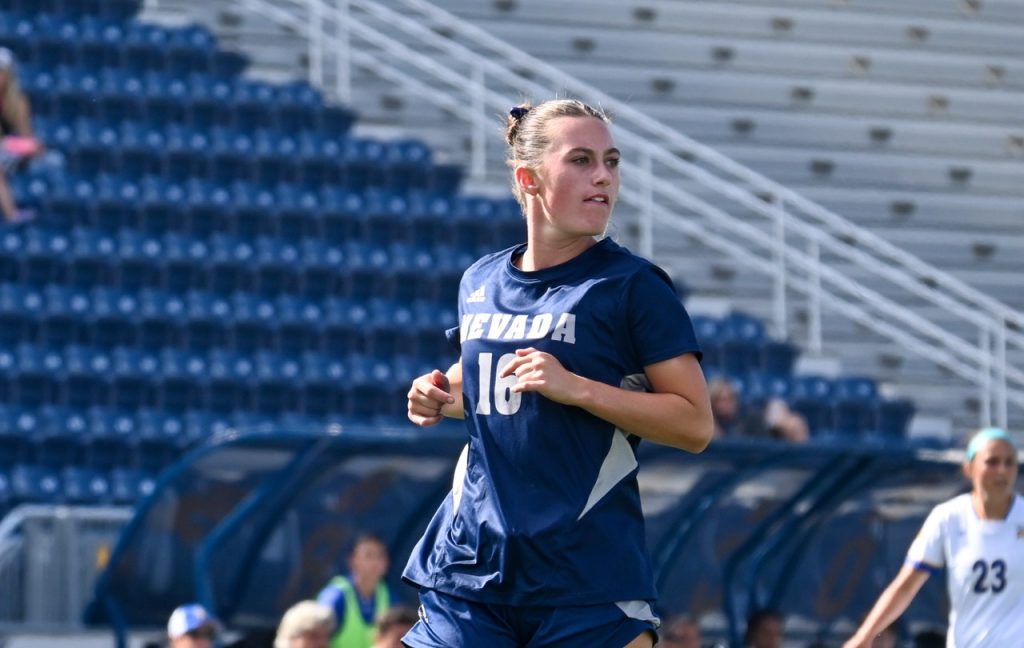
“I think his coaching style focuses more on our team as a whole, and our team’s success, rather than adapting to the way that other teams play,” Olivia Loomis, Nevada senior forward, said. “He’s very, like, he’s direct with what he wants, but is very complimentary when we succeed at it. And he lets us know when we’re succeeding at it, and encourages us to keep up the good work.”
Loomis is in her fourth year, and has spent her entire college career with the Wolf Pack. With Evans’ arrival, she’s noticed a change in mindset.
“There’s been a lot of changes to the team,” Loomis said. “As far as player-wise, I think that there’s maybe only, like, 10 returners from the prior fall that are currently on the roster now.”
Loomis also discussed how the team has changed on the field, especially in the eyes of competitors.
”I think we’ve really adopted a style of play,” Loomis said. “I feel like in the past, we’ve kind of tried different things, and some of which have worked, some of which haven’t. But I feel like [other teams] almost didn’t know what they were gonna see out of us, but I feel like now it’s like ‘we’re playing Nevada, they like to build out of the back, they like to possess, they like the ball on the ground. They’re not trying to go super direct.’”
In his first year with the team, Evans agrees that he has tried to make some changes with the program.
“You know, I can bring in some players, from a soccer perspective, that maybe are a little older, more experienced, and they play the way I want to play,” Evans said. “So I think we did that right away.”
Reshaping a team takes time, and after less than a year as head coach, Evans hasn’t yet had that time. But, he’s worked hard to do what he can to make the program the best it can be.
“We’re not all the way there yet,” Evans said. “You know, there’s only so much you can do when you get the job in December, January, right? But I think we’ve made some strides, bringing in players with good experience, the way I want to play. And then obviously embracing the returners that came back and how hard they worked over the spring.”
Despite transitioning from community college to the NCAA and working to make changes in Nevada’s soccer program, he hasn’t adapted his own coaching style.
Many former Coyotes made the transition to the NCAA at the same time as Evans, following him from Lake Tahoe to Nevada. Avery Hayes, a sophomore at Nevada who spent her freshman year under Evans at LTCC, says that despite the transition, he’s stayed consistent.
“Playing with him up in Tahoe, he held us to very high standards,” Hayes said. “He treated us very, very well. He pushed us very hard, but knew what we were capable of. And then him coming down to Nevada, I think everything’s a little more intense.”
Hayes also explained how engaged Evans is in practices, and how it helps his players.
“I think he definitely expects a little bit more from all the players here, because of the [higher level of play],” Hayes said. “But it’s the same fundamentals, it’s the same drills, it’s the same energy that he brings, and he’s very involved in practices, which is nice. He will come into a drill and show us an example, and he will participate in the drill, and he’s watching the entire drill, he has a whistle, he’s never sitting down, he’s never focused on something else. We’re always his top priority.”
The care Evans puts into the program extends past winning soccer games, but for the athletes themselves as well.
“I mean, obviously, I’ve been a sports writer and a writer, and I’m a coach, and so I feel like sometimes the microscope’s on me, and that’s fine, but ultimately, like, I want this to be a player’s program,” Evans said. “I want it to be about them in Nevada, right? Those to me are the real special qualities. […] I just want to make sure that my players get the recognition they deserve.”
The 2026 season didn’t go the way the Wolf Pack had hoped, finishing 5-13-1 with a 2-7-1 conference record. Both of the Pack’s conference wins came in their last three games of the season, showing small but important improvement. Both Evans and Nevada athletes see the potential and the growth, and have big hopes for the future of the program.