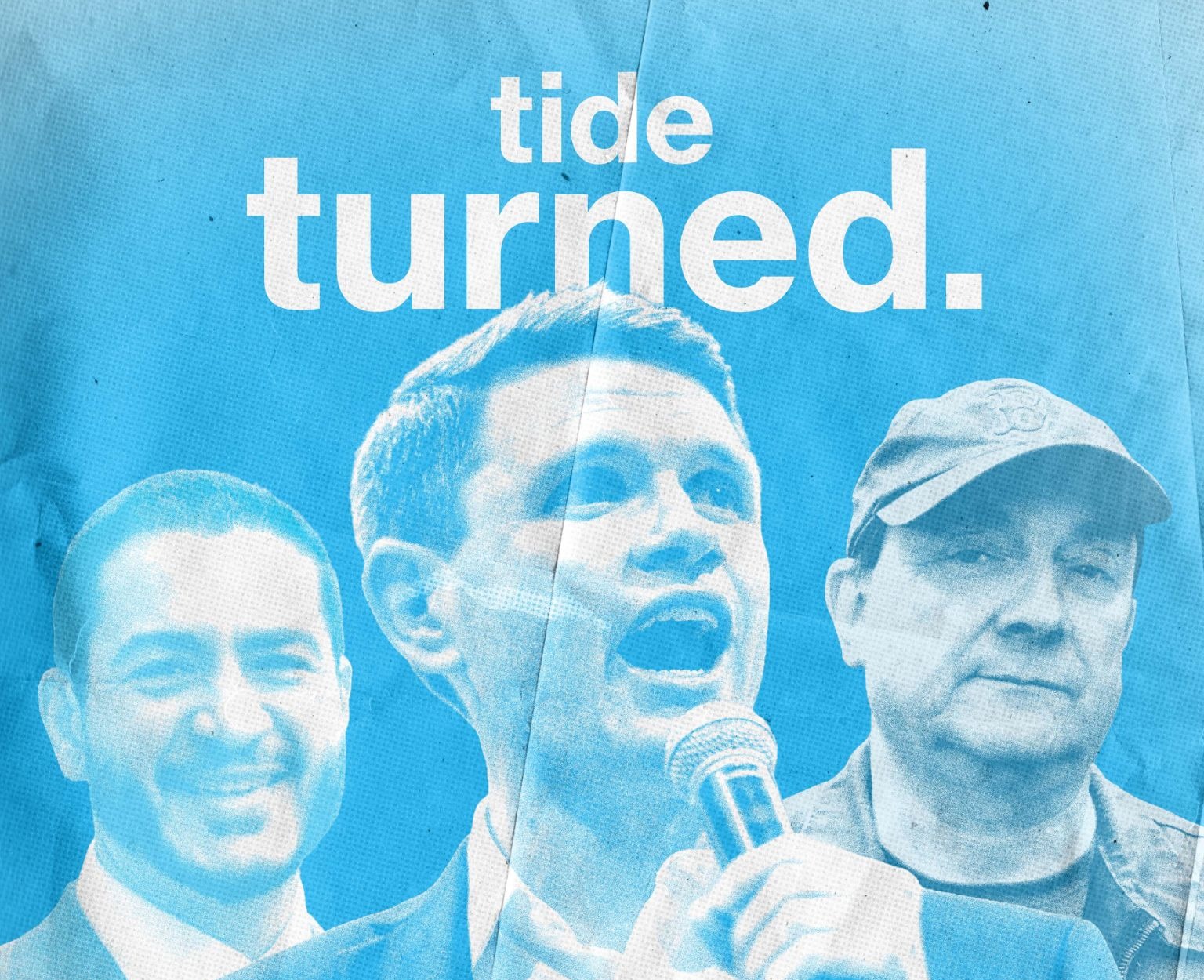

Whether the Democrats’ earth-shattering victory in the midterm elections Tuesday night is more of a rebuke of the Republican party or an embrace of the Democratic brand remains to be seen. But one thing is certain: the Democratic party benefited from their fractured, decentralized nature. While the party has recently struggled to find its central message, or messenger, a broad range of candidates emerged victorious in their races — perhaps because of their party’s lack of cohesiveness.
All throughout the primary season and run-up to the November elections, questions about the Democratic party’s future dominated the national news cycle, and for good reason. A slew of progressive Democrats had won their primaries, fueling the growing left-wing movement that has ignited a family feud inside the Democratic tent. The feud between the moderate and progressive factions of the party has, at times, spilled over into the general election races between Republicans and Democrats. However, Tuesday’s victories, which netted the Dems both chambers of Congress, proved that there is no singular way to win.
All over the country, especially in high-profile races that will shape political narratives for the rest of the 2020s, different types of Democrats, promoting different policies, have won. Both moderate and progressive candidates were able to see great success all while running campaigns that were nothing like each other. Troy Jackson and James Talarico, two politicians who contrast in both style and substance, flexed their electoral muscles as the soon-to-be senators flipped Republican-held seats in a dramatic fashion.
Jackson, the new senator-elect out of Maine, knocked off 30-year incumbent Susan Collins in one of the marquee races of this election cycle. Collins had been in this position before. Six years ago, the longtime legislator was staring down the barrel of unfavorable polling before rattling off an 8-point win. 2026 was different, as Jackson inherited the progressive campaign of Graham Platner, who had left the race amid sexual assault allegations. From there, the failed gubernatorial candidate-turned Senate nominee picked up right where Platner left off, sporting many of the same left-wing policies that had made Platner so popular.
On the other hand, Texas State Representative James Talarico will become Texas’ first Democratic senator in nearly 40 years, besting Republican nominee Ken Paxton by double-digits. Talarico’s race focused much more on his bipartisan appeal, opting for a campaign centered around what he called a “politics of love.” While Talarico himself supports many of the same progressive policies that Jackson does, he made that support much less apparent en route to his historic triumph. The senate hopeful campaigned on an immigration agenda that differed from that of former president Joe Biden’s administration, while still criticizing President Donald Trump’s border wall. Talarico even went as far as to run an ad criticizing Biden’s border policy, showing his willingness to embrace moderate positions.
Though both campaigns were somewhat similar in substance, they were polar opposites in terms of style. Jackson’s unabashed, rough-around-the-edges persona was in complete contrast to Talarico’s polished speeches and go-lucky attitude.
During his time in Maine’s state senate, where Jackson served as president of the body, the now senator-elect earned a reputation as somewhat of a hot-head. He was once accused of throwing a water bottle in an outburst during a meeting with fellow Democrats. Jackson’s unamused, brusque brand has followed him into national politics as well, where he consistently mocked Collins for touting the fact that road salt was taken off of Trump’s tariff list.
“People across the political spectrum are hungry for a different kind of politics,” Talarico said during his victory speech on Tuesday. “Not a politics of hate. Not a politics of fear. Not a politics of division, but a politics of love.”
During his campaign, Talarico often focused on bringing people together rather than rushing to a partisan corner — trying to capitalize on America’s increasing political divide.
What both candidates have in common is that they benefited from the freedom to run races specific to their personalities and their states, rather than being tied down to a national brand — something that Republicans failed to do. While Talarico and Jackson are just two examples in the sea of diverse Democrats who won big on Tuesday, they represent the kind of campaigns that won all over the country in what was a seismic shift in American politics.
The potential negative effects of a national brand are obvious, as an unpopular head of the party (usually a president) may easily become a drag for candidates running in races from the same party. Perhaps nowhere were these effects more evident than on the other side of the aisle, in the Republican party. Here, G.O.P. nominees were easily tied to the unpopular policies of Trump and his administration, such as the war in Iran and immigration reform. This linkage resulted in one of the most lopsided elections in the modern political era, even outpacing the 1994 Republican Revolution that handicapped President Bill Clinton’s first administration.
Democrats have succeeded in pulling off the party’s largest victory of the Trump era, in part due to the range of candidates who won their races in their own ways. These were candidates who were able to run on and focus on the issues that mattered to their voters, whether that be the price of road salt in Maine or the ongoing conflicts in the Middle East. Democrats were able to pave their own paths to office, and their party won bigger because of it.