
By Teagan Greer and Ella Strobo
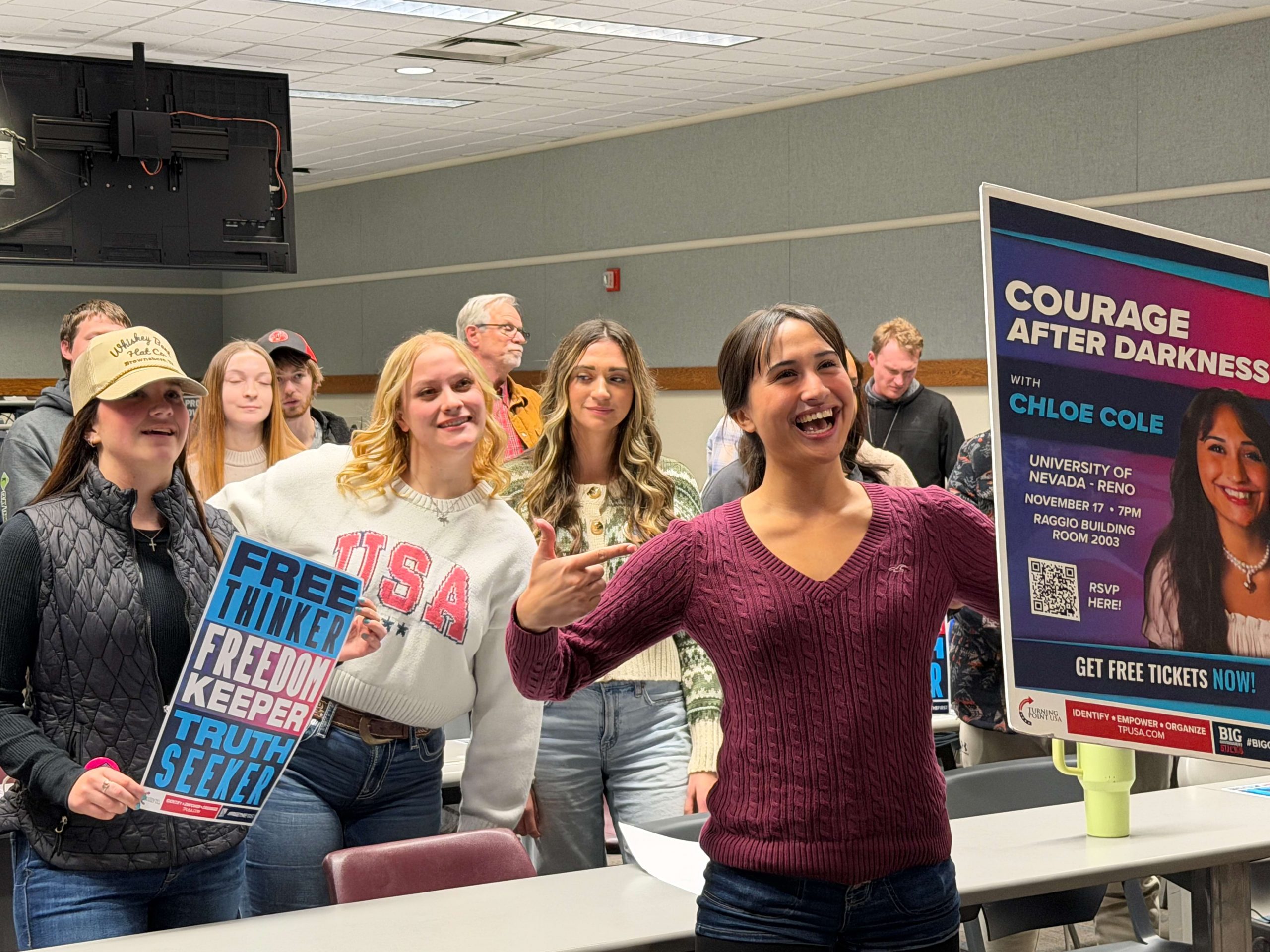
21-year-old detransitioner and political activist Chloe Cole visited the University of Nevada, Reno on Nov. 17 on behalf of UNR’s Turning Point USA chapter, a conservative youth organization founded by controversial conservative activist Charlie Kirk, who was recently killed at a speaking event at Utah Valley University.
Cole gave a speech at the Courage After Darkness event, an event made specifically to host her as guest speaker, advocating against gender-affirming medical care for minors. She brought up her own story about how she regretted transitioning, stating to have taken puberty blockers and hormone injections at age 13; she also stated she had a double mastectomy at age 15, after which she regretted transitioning.
Cole claimed that the LGBTQIA+ community turned its back on her after she detransitioned. She also said that the community she was a part of told her it was her fault for transitioning and even went as far as to tell her to end her life.
“I was like garbage to them,” Cole said.
Since detransitioning, Cole has built her platform on being a detransition activist speaker, working with organizations such as the Young American Foundation and Turning Point USA to spread her message.
Cole claimed that when she was considering transitioning, doctors asked her parents, “Would you rather have a dead daughter or a living son?”
Cole has sued the Kaiser Foundation Hospital, which performed the gender-affirming surgery on her. The law firm representing Cole is Dhillon Law Group. Cole announced at the Courage After Darkness event that this case will be going to trial.
Reaksmey, an 18-year-old UNR student and transgender man who didn’t attend the event, spoke with The Nevada Sagebrush about his experiences transitioning. He said the time he has spent with doctors has varied immensely from Cole’s experience with the medical system.
“They [the doctors] did ask me, like, ‘are you sure about this?’ Like, ‘how long have you been feeling this way?’ And they also referred me to go to a therapist to see if I could possibly get diagnosed or if this stemmed from something else. When I talked to my therapist about it, they seemed very open, again, very in-depth questions on, like, what to do, how I’m feeling, why I’ve been feeling this way, what I would do – like what solutions I can do in case if I wasn’t actually trans,” Reaksmey said.
Cole said she wanted to transition because she had body image problems and that she often looked up to her brothers.
Reaksmey’s early encounters with gender dysphoria also involved his brothers. “For me, I copied my brothers. I felt envious of my brothers. Like, I would genuinely, like, I would cry myself to sleep wishing – wishing I was a boy,” Reaksmey said.
Throughout her speech, Cole spoke about not being a “one-off case,” saying that there isn’t enough studies or information on people who detransition.
Despite Cole’s experience, researchers have repeatedly found low rates of regret among those who receive gender-affirming surgery. One such study published in the Journal of Adolescent Health notes, “Systematic reviews of regret related to non gender-affirming surgical interventions found an average regret rate of 14%-21%. This is at least seven times higher than current estimates of regret reported for gender-affirming surgeries which range from 0.5%-2%.”
Some researchers believe it is crucial to study detransitioners and those who regret their gender-affirming surgeries in order to improve how the system handles medically-assisted transitioning. Addressing regret and detransition cases has been a little-considered subject within the medical field, though that has been changing.
Cole says that it’s harmful for children’s bodies that are still developing and who have to go through puberty to transition. “The issue is entirely psychological,” she said.
While claims that widespread medical transitioning is occurring for children are common in the media, very few minors in the United States receive gender-affirming medical care, and even less receive gender-affirming surgery. A PBS article published this year notes, “Fewer than 1 in 1,000 U.S. adolescents with commercial insurance received gender-affirming medications – puberty blockers or hormones – during a recent five-year period.”
Although studies report that youth who undergo medical transitioning show positive outcomes for mental health, there can be risks to a patient’s physical health. One study notes in the case of Gender Affirming Medical Care such as puberty blockers and hormone therapy that, “These risks can include decreased bone density, changes in the body density, reduced cardiometabolic health, and, perhaps most notably, fertility issues.”
During her speech, Cole addressed that 26 states have implemented laws to prevent children from receiving gender-affirming care. According to KFF, a non-profit focused on tracking health policy in the US, 27 states have implemented laws or policies limiting youth access to gender-affirming care. President Trump passed an executive order that directs federal agencies to try and limit access for minors to gender-affirming care, titled “Protecting Children From Chemical And Surgical Mutilation.”
Cole is also lobbying to pass the “Chloe Cole Act” in U.S. Congress, which would prohibit minors from receiving surgical and hormonal gender-affirming care from health care providers.
Reaksmey, although sympathetic to Cole, is disheartened by legislation that targets gender-affirming care.
“Just because transitioning didn’t work out for them [those who chose to detransition], it doesn’t mean that it won’t work out for everyone. Because if you think about it, detransitioners are such a small, small percentage. (…) So just like, that very small voice having the possibility to take away genuinely life-saving care is really sad, but I don’t want to take away from their story too, you know?” Reaksmey said.
Cole claims that if medical transitioning for minors is banned, youth suicide rates would decrease.
“So, I think that what it looks like [preventing childhood suicide rates] is not only removing the option of transitioning and the mindless affirmation from the picture, but focusing instead on the overall hold of life for the child and their overall personal history,” Cole said.
Child suicide rates because of restricted access to transitioning are significant.
According to The Trevor Project, an LGBTQ+ advocacy organization, there was, “a significant increase in suicide attempts among all participants whose home state had enacted at least one anti-transgender law. The highest increase in suicide attempt rates – ranging from 7% to 72% – was reported among participants younger than age 18.”
Cole also recommended looking into the history of the child, such as family trauma and sexual trauma, and considering diagnoses like ADHD which she said is, “common among children who experience gender confusion.”
Cole said that when further bans on child transitioning pass, they “need to have a clause, or they need to be followed by another law that will require proper counseling for these children.”
There is no clause in the Chloe Cole Act that would require counseling for children who don’t have access to transition care.
Reaksmey shared some thoughts based on his own experiences with and knowledge of gender-affirming care: “Trans people benefit from gender-affirming care, whether it’s like actual medical things or even the most mundane stuff. This stuff saves people, and even if someone turns out to be wrong, it’s because of those treatments that allow them to detransition that allow them to go back to being comfortable in their body. It’s not fair to remove something that’s, like, so important. Like, okay, this is like triggering (…) but, like, I wouldn’t be here without health care, like this specific health care,” he said.
During the event, Cole touched on other topics besides gender-affirming care, including the “war being waged against conservatives,” emphasizing how those with right-leaning ideologies are treated on college campuses.
“Every single person I know who is conservative can attest to the violence and victimization and ostracization they face here [on college campuses],” she said.
There was one protester that night at UNR who argued against Cole.
Although not affiliated with UNR or a member of the LGBTQ+ community, the protestor, Lindsey, told the Sagebrush she felt compelled to speak out against Chloe Cole and Turning Point USA. “I’m just extremely concerned about, you know, some of the fascist ideas that the current administration has been putting forward, and I think one of the most important ways to combat fascism is to stand up for vulnerable minorities, and I think that the trans community is probably the most vulnerable minority there is right now,” Lindsey said.
Lindsey first garnered the attention of Cole and the audience by posing a pointed question at Cole during the questionnaire period of the event. Lindsey turned to those in attendance and implored them to “Raise your hand if you make over 200,000 dollars a year”. She waited a moment and then spun around to face Cole, asking her the following: “Why didn’t you raise your hand?”
Lindsey went on to claim that Cole was paid for promoting conservative propaganda repeatedly, which Cole denied. Lindsey mentioned Elon Musk in this confrontation with Cole, declaring that Turning Point USA is funded by an “African immigrant” on more than one occasion. This statement elicited groans from the crowd and Lindsey backed down for the time being.
She didn’t speak again until later in the event when she began shouting about a “rape island,” presumably referring to infamous criminal Jeffrey Epstein’s private island Little Saint James.
Lindsey’s interruption prompted collective irritation from the crowd as well as from the event coordinators, who requested that she leave the premises.
Back in the event, Chloe Cole urged college students everywhere to “get involved”, directly quoting the Turning Point poster behind her. She encouraged students to join Turning Point USA chapters at their schools in order to combat the presence of what she called “radical left wing ideology” on college campuses across the United States.
When asked about the outcome of her efforts to protest that evening, Lindsey commented, “Yeah. So, it wasn’t the dialogue that I had hoped for (…) if you are going to allow propaganda on campus, I think that there should be a chance to hear both sides, not just the one side.”
Ella Strobo can be reached via email at el********@***il.com. Teagan Greer can be reached via email at Te*****@*nr.edu.
For tips, complaints and corrections, please contact News Editor Riley Overstreet via email at ro*********@*nr.edu.