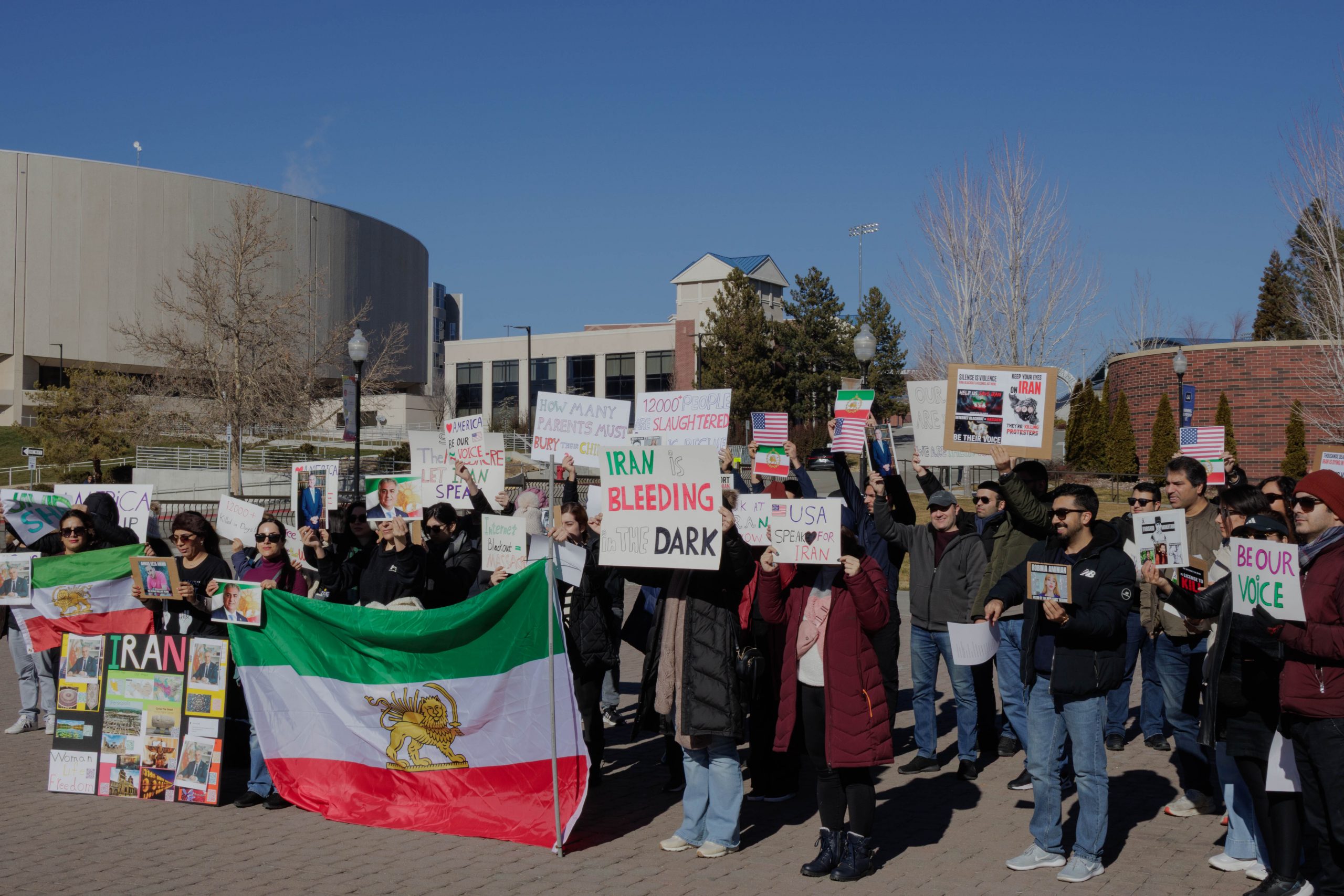

Over the last month, Iranians have taken to the streets in a series of escalating protests that have been met with a violent response from the state. On Jan. 8, the Iranian government instituted an internet blackout in the country as the death toll rose. Locally, Iranians held a rally at the University of Nevada, Reno on Jan. 14 in support of these protestors in Iran.
Reno demonstrators chanted near the Joe Crowley Student Union, holding signs criticizing the Islamic Republic. Chants included “Down with Khamenei,” “What do we want? Regime change in Iran!” and “Make Iran great again.” Multiple demonstrators interviewed by the Sagebrush reported having family members in Iran who they’ve been unable to contact since the internet blackout began.
“Yeah, actually, my family, all of my family, are in Iran. I know that they have been in the street too, like the others — my brothers, and I have no news about them,” said Arman Sharifi, one of the demonstration’s organizers.
Since the protests began, thousands have been killed, though the exact number is unclear. Demonstrators in Reno cited 12,000 deaths or more, which was also reported by CBS News on Jan. 13. The New York Times reported on the same day that an anonymous official from the Iranian health ministry told them that at least 3,000 people had been killed, with the figure including protestors and Iranian security forces.
The official death toll released by the Iranian government on Jan. 21 also claimed over 3,000 deaths, while human rights groups have listed numbers ranging from 4,519 to over 20,000.
The protests began in late December over frustration with worsening economic conditions, but spiraled into general expressions of discontent with the Islamic Republic.
“It started with the economic depression. So there’s been a lot of environmental, economical, social shutdowns,” said a demonstrator named Homay, who asked to only be identified by his first name.
A demonstrator named Amir Sharifian, holding a sign that read “Javid Shah,” meaning ‘long live the Shah’ in reference to the king of Iran who ruled the country prior to the 1979 Islamic Revolution, expressed support for foreign intervention against Iran.
“We are waiting for any help of the United States because, like they did for Venezuela, like they did for Maduro, they went there and took this dictator out… people of Iran are chanting for the same thing,” Sharifian said.
Arman Sharifi said, “Just know about the situation and tell the others about the situation, and put pressure on your politicians, the government, to help our country. And they can, your leaders, can help us in many different way.”