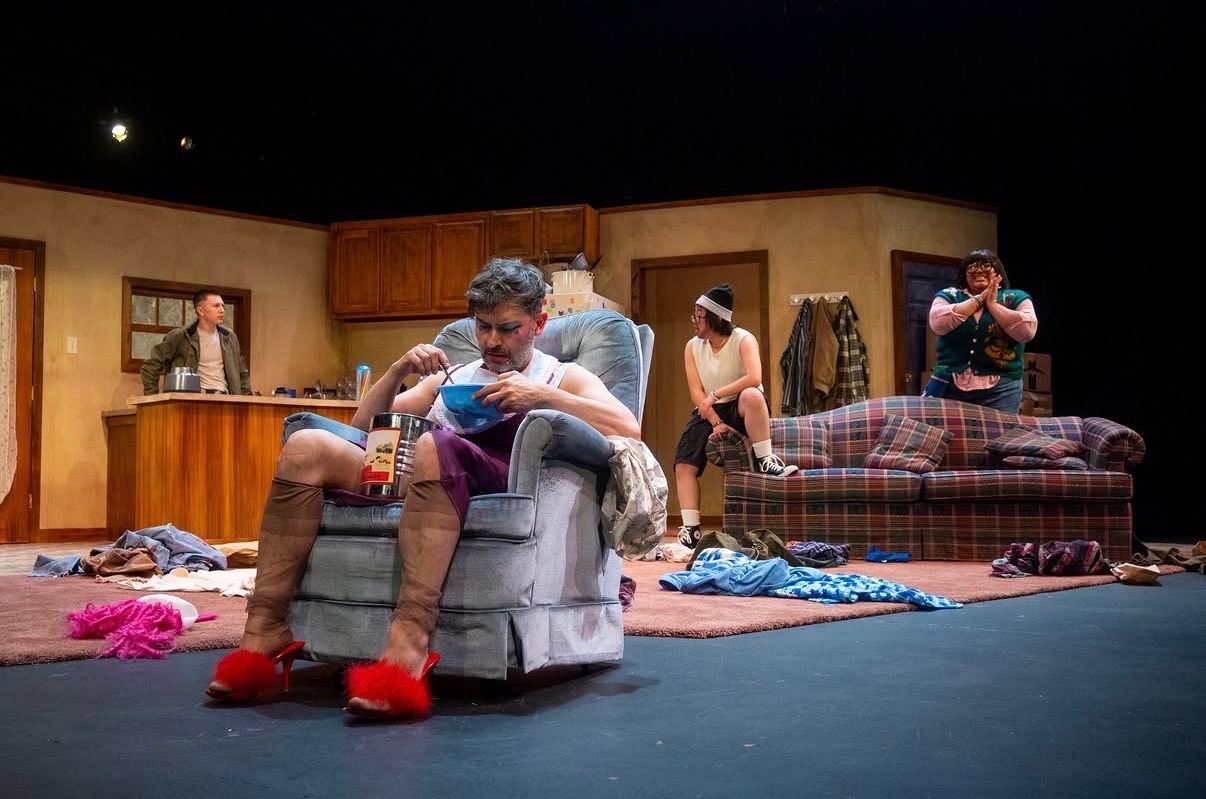

Photo provided by Rachel Jackson
The Department of Theatre and Dance at the University of Nevada, Reno produced the play “Hir” by Taylor Mac from April 10 to April 19. The four-person play is set in contemporary California and centers on a family’s struggle with adapting to traditional American familial expectations.
Isaac, a young Marine, returns home after a dishonorable discharge only to find his home entirely uprooted from what he remembers three years ago. His abusive father, Arnold, suffers a stroke, his sibling, Max, is exploring new gender identities and his mother, Paige, dismantles the family routines and orderly behaviors as a result of her newfound liberation from her husband.
The story follows Isaac as he attempts to reset his home back to accommodate his comfortability, but he fights resistance from Max and his mother.
As Isaac learns more about his family’s transformation, his desire to reverse it becomes more chaotic and raises old and new issues alike. The tension in the story forces the characters to come to terms with the unaddressed changes and find a way forward.
Taylor Mac describes this play as a dark comedy riddled with internal family struggles, incorporating an “absurd realism” style. “Hir” discusses a variety of emotional subjects: gender identity/fluidity, dismantling patriarchal systems, domestic violence and its impact and “the tension between social revolution and personal responsibility.”
The cast features Ora Harris as Paige, Jude García as Isaac, Wilbur Jahn as Max, and Eduardo Arce-Gutierrez as Arnold. Other production members include Nate Hodges as fight choreographer, Leam Hummel for costumes and Kyle Blomquist as scenic designer.
The actors carried the intensity of the content throughout the show and led audiences to experience emotional whiplash as they jumped from laughter to discomfort. The topics addressed in the play are not easy to navigate, but the cast smoothly guided viewers through each character’s interpretation of the events.
The play’s content expressed depth within the topics, but left a large part of the audience feeling emotionally heavy. Listening to dialogues about domestic violence and oppression, for example, gave audiences the opportunity to not only understand the characters’ point of view, but also potentially reflect on their own experiences with those topics.
Not every story has a happy ending; this story definitely communicates that sentiment. Isaac is kicked out for physically harming his mother and fighting with the rest of his family members, while also struggling with his own recently developed PTSD and triggers. The abrupt ending forced audiences to sit in the deep, uneasy atmosphere and pause to ask if that really was the end.
The set of “Hir” visibly demonstrated the polarized dynamics fighting for power within the family. The messiness and unruliness of the set, like the tidiness of the home, subconsciously signaled who was in control of the scene depending on the extremity of the disorder.
Choreography played a key role in the story, physically moving the dialogue to help audiences visualize the struggles better.
Assistant teaching professor of theatre and director of “Hir,” Sandy Nease, reflects on her experience working on the show. “I’ve truly enjoyed diving deep with the actors to build the world of this play and craft the layered characterizations that bring this family to life,” she said. “This piece is both challenging and exhilarating to work on. It’s filled with sharp humor, but it also explores themes that resonate in profound and meaningful ways.”
“Hir” illustrated many intense but integral struggles society often faces. The themes presented in the show are not always commonly discussed or faced in healthy ways, but the cast and team members behind “Hir” executed a passionate performance that served as a point of reflection and confrontation of the struggles faced by the story’s individual characters and the family unit as a whole.