
The Supreme Court of the United States ruled to rescind longstanding campaign finance restrictions that political parties can directly make to candidates. This conclusion is among several other landmark decisions that the Court made on Tuesday.
The decision allows political parties at both the state and national level to spend unlimited amounts of money in an effort to elect a candidate. This ruling overturns a 2001 case in which the court upheld the previous restrictions on said spending.
In recent years there has been an exponential uptick in campaign spending, from both individuals and donors, though of course, the donor class far outpaces individual contributions. This increase in spending became most prominent in the 2024 election cycle, which saw Elon Musk, the world’s richest man, give over $250 million to Donald Trump’s presidential campaign.
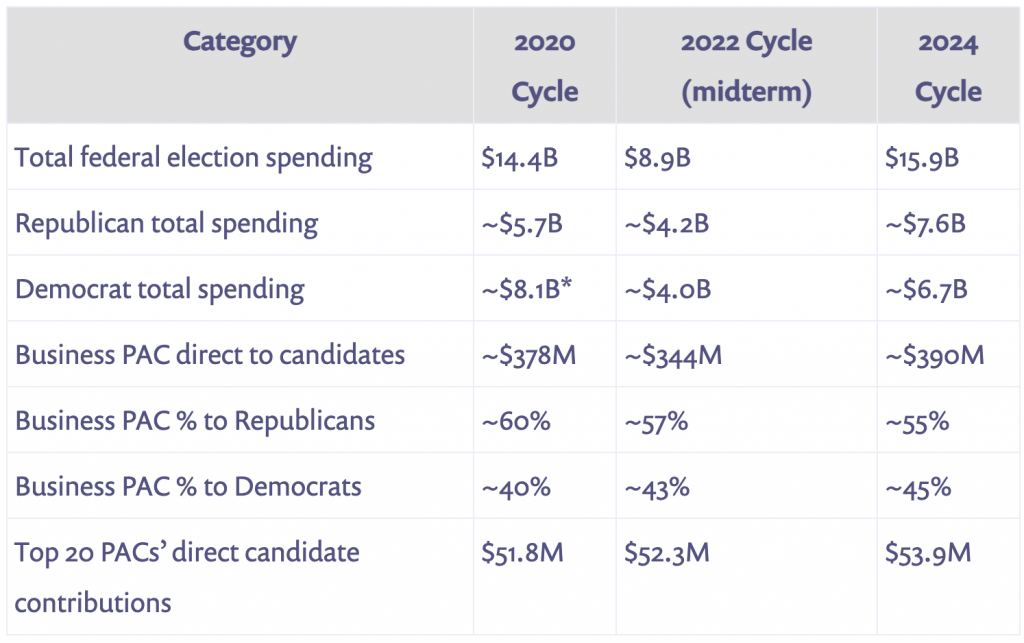
Chart of political spending over the last three federal election cycles. (Image courtesy of Quorum)
The uptick in spending did not stop at the presidential ballot though, as localized, state races have also seen the same trends. A 2025 Wisconsin Supreme Court race attracted over $100 million spent between the two leading candidates.
So looking forward to November, how will this ruling perhaps change the outcome of some races?
Starting at the federal level, it is important to note that there really aren’t that many competitive congressional races anymore, especially after this and last year’s redistricting wars. Along with the hyper-partisan gerrymandering that has taken place, a general increase in polarization has moved some districts away from the “battleground” label.
With that being said, the ruling is expected to benefit Republicans the most, who already face an uphill battle to maintain control of congress after they won both the House of Representatives and the Senate just two years ago. Though midterm elections tend to benefit the opposition party, whoever that may be, this year’s will likely be even more of an outlier, closer to that of the 2018 midterms in which the Democrats picked up the most house seats since the summer of Watergate.
Republicans have attracted more large donations from corporations and the ultra-wealthy (such as the aforementioned Musk) in recent years. Coupling this with the fact that more and more left-leaning candidates are refusing to accept corporate Political Action Committee (PAC) donations, the seas have parted for the Republican party to easily outraise Democrats in some races. Though some candidates refusing these donations have used their fiscal integrity as a talking point in their races, in turn, boosting their campaigns.
As far as Nevada goes, none of the state’s members of congress have sworn off PAC money. Neither has David Flippo, the Republican nominee and likely replacement to Mark Amodei in the second congressional district, which spans Northern Nevada. All of this likely means that parties in the silver state will do as much as possible to capitalize on SCOTUS’ new ruling.
In Nevada, the Republican party has quite the funding advantage already, especially as it pertains to the hotly contested race for the governor’s mansion. Here, Governor Joe Lombardo, the incumbent, has over seven times the cash on hand than his Democratic challenger Aaron Ford, and given Tuesday’s ruling, one can only expect Lombardo’s war chest to grow. And in a race that is set to be one of the closest in the country the difference in funding may mean the difference in votes.
Over the next couple of months, one can expect an excess amount of cash to flow into races all throughout the country, and especially in Nevada. Though only time will tell if the likely increase in spending can buy voters’ goodwill or if they’ve become all too weary of big money in government.