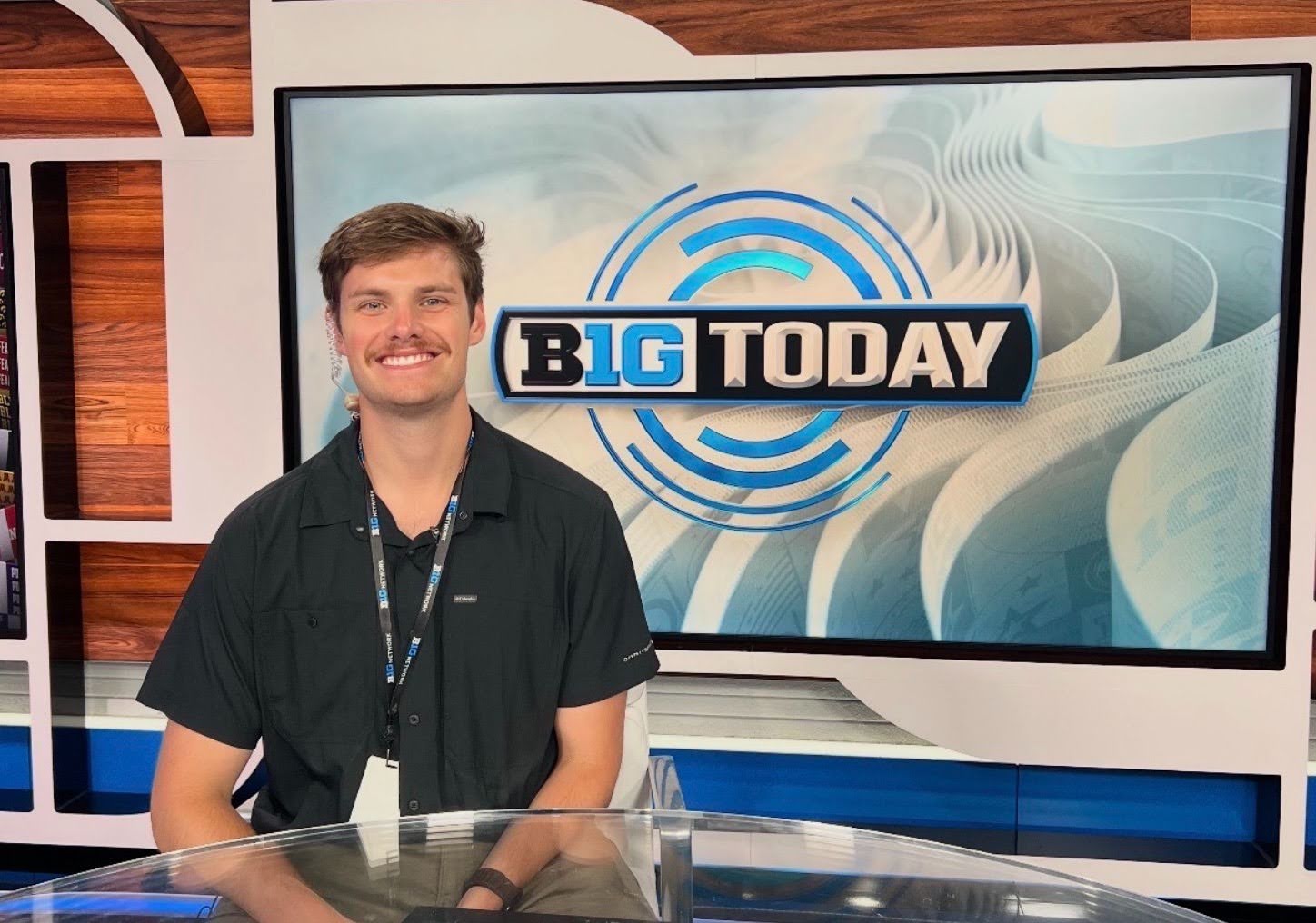

On a windy and overcast day, the small press box above Ault Field in Mackay Stadium came into view. The crowded space that served as the control room for the University of Nevada’s broadcasting team resembled a cave of technology, humming with AV and broadcasting equipment. Inside was Caden Kesselring, the University’s coordinator of AV and broadcasting, who joined the Nevada broadcast staff last September.
Kesselring is no stranger to unpredictable conditions – the constant rain in his hometown of Portland, Ore. has prepared him well for the environment, including his new position here in Reno.
“[Portland] is kind of a weird city,” Kesselring said. “The weather is rainy 11 months out of the year.”
Despite the nearly 43 inches of rain the city gets every year, it fosters a unique community – especially when it comes to sports. Portland’s outdoorsy air meant that everyone spent time outside.
“It led everyone to playing sports; whether it’s skiing or something, to soccer … the biggest thing there,” Kesselring said.
Kesselring added that he played a little bit of everything growing up, but that his interest in broadcasting started when he was young, while his mom was working in public relations.
“Coming home from school, I would see like five different TVs of news on at the same time, just different channels … I would be like, ‘this is just awful,’” Kesselring laughed.
After he had adjusted to the media bombardment at home, he was “accidentally” placed into a broadcasting journalism class in high school. Put into the course by a counselor in order to add an elective into his schedule, Kesselring decided he liked it and continued taking the class until the end of high school. This is where his love of sports mixed with his affinity for broadcasting.
In 2021, Kesselring became a student at the University of Oregon, where he majored in broadcast journalism.
“Sports are pretty dominant [at UO], and they just have so many opportunities for them,” Kesselring said. “I just kind of expanded; they have minor league teams and all this stuff where you can progress your skills.”
In 2024, the University of Oregon left the Pac-12 division to become a part of the Big Ten conference. Kesselring said the merger was extremely beneficial to his time at the university.
“The Big Ten had so much more money than we could fathom,” Kesselring joked. “We were given this money to expand our control room and all of the broadcast equipment, and we just kind of ran with it.”
Alongside a new budget for the broadcasting team, the merger allowed students like Kesselring to participate in a program called Big Ten Student U, where any sports broadcasts at a Big Ten school that weren’t nationally televised were completely student-run.
“That’s probably the biggest thing,” Kesselring said, “You’re giving kids real-life experience where it’s live-streamed on Big Ten Plus. Directing and producing Oregon basketball at the time, we were hitting a consistent 100,000 people watching … in a professional control room. I think that really expanded the experience.”
Kesselring said one of his most demanding experiences came while working with NBC on the World Championship track events at Hayward Field.
“It was probably the most tiring part of my life,” Kesselring laughed. “I think I’m still sleeping that off.”
Working alongside NBC crews from Great Britain and Japan, Kesselring helped produce the World Championship broadcast for its first time on American soil. Working 17-hour days while getting to create connections with NBC, Kesselring said it was a once-in-a-lifetime opportunity. One moment stood out: participating in running the track himself, alongside some of the greatest athletes in the world.
“We were having a set day right before the events started, and NBC was working on getting one of their robot cameras synchronized, so they needed us to run the track to test the timing of it,” Kesselring said. “So, I was one of the people, and it was a 400-meter run… it was me versus seven other 400-meter world champions. I was like ‘Why, why,’” he laughed. “That was fun, I get to say that I ran at the World Championships.”
Unlike his experience at the University of Oregon, the University of Nevada, Reno presents outdated equipment, less relevant sports teams and no primetime television spot. For Kesselring, this means a whole different broadcasting experience.
“I knew that Nevada was not in the Big Ten,” Kesselring said. “They didn’t have the resources that a bigger school would have… consistent football teams, basketball teams; you’ve got to have these programs where they bring in money and NIL deals and TV deals, but I knew coming in that it would be different.”
With some technology that’s nearly six years old, and a smaller budget, Kesselring has to pick and choose different equipment to use for a broadcast.
“But, I mean, we get it done,” Kesselring said. “If something happens, we find loopholes and we make it work. We’re very creative about that; it’s what I like about the job. Everyone here is fun and is just really positive.”
With so much creativity on his team, Kesselring has a few goals he wants to bring to life at the University of Nevada.
The first goal is constructing a new control room, which is already in progress at the Lawlor Events Center. The new, professional-grade control room will offer easier access for TV networks to broadcast events. The second goal is to get funding for new, up-to-date equipment. The third goal, and arguably Kesselring’s most important goal, is to turn the broadcast into a completely student-run effort, so that students can get real, on-field experience.
“That’s what a school is,” Kesselring said. “TV broadcasts are hard to do, and you need professionals in that field. But, if you’re at a school, students need to learn, and you need experience to graduate. I want to give those students experience and see what it’s like in the real world.”
“We are building this student program up right now; I think we have 15 students. At some point, while I’m here, I want to make it so it is student-run. I want students to produce and direct these games and I don’t have to be here,” Kesselring laughed. “So I can sleep at home.”
Despite the long hours and the new environment, Kesselring said there’s nothing more fun than jumping into something new.
“Something is going to go wrong everyday. In any control room something will go wrong, but in this one, it’s stuff that people have never seen before,” Kesselring said. “That’s what I like about it. It’s relaxing to know that this is what we have, and this is what we could get,” he adds, referring to building the student program up.
With a new AV and broadcast coordinator like Kesselring, it is clear that students will soon have a bigger part to play in broadcasting University of Nevada sports, introducing better work experience, roles and giving them more recognition during their time at the university.