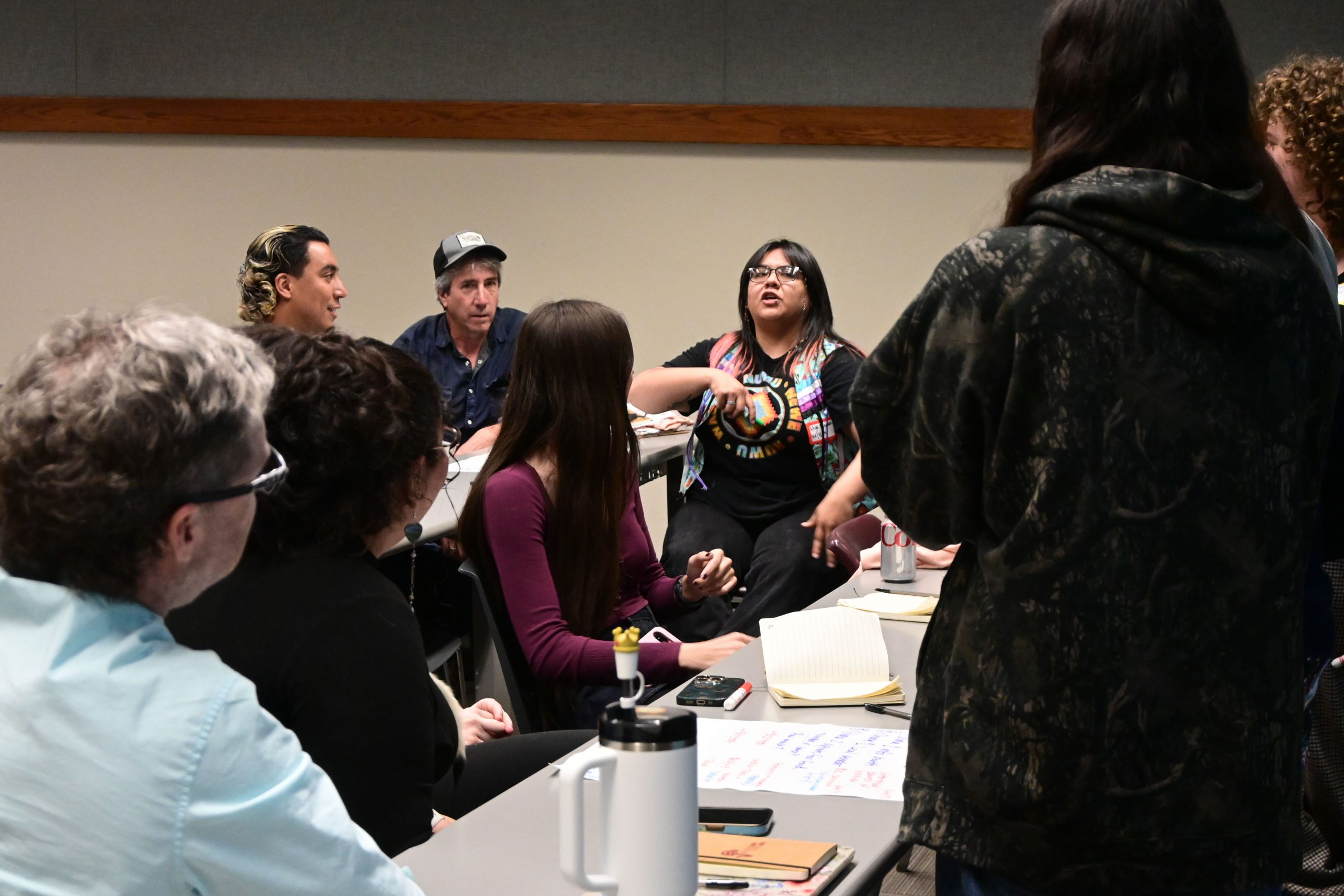

The American Civil Liberties Union (ACLU) of Nevada and the Native Voters Alliance (N4VA) hosted an event on the University of Nevada, Reno’s campus on March 28 featuring presentations and workshops hosted by Native American advocates. Speakers focused on topics including politics, the environment, art and Native American culture.
According to Hannah Branch, a policy advisor with the ACLU of Nevada, a Nevada based organization that focuses on “civil rights and individual liberties,” the purpose of this event was to give community members the opportunity to utilize their stories to attain progress towards indigenous justice goals and civil rights and liberties projects. According to Branch, the event is important because, “Communities are most powerful when we work together.”
This event was used to “build space where individual stories mattered and practice using those stories to advocate for change,” said Branch.
Many of the presentations were based on advocacy efforts, including how to speak up to local officials, how to protect yourself online and engage in digital advocacy, how to use art and storytelling for advocacy and how people can connect with Native communities by learning their practices and cultural customs.
Jo Montelongo, community organizer of the Native Voters Alliance Nevada (NVA), a Nevada-based organization that seeks to empower Native voters organized the event alongside Branch.
According to Montelongo, the NVA is currently advocating against the proposed Safeguard American Voter Eligibility (SAVE) act.
“The SAVE act is going to make it difficult for anybody to vote, especially Native people. It requires people to present ID’s or official certificates that usually are not presented or given to tribal members,” Montelongo said.
Reporting from KUNR notes that although the bill claims to allow for tribal IDs instead of other proof of US citizenship such as a passport or birth certificate, tribal IDs often don’t have a place of birth written on them, disqualifying them as a valid form of voter ID under the potential SAVE Act.
Since polling locations are often far away from tribal lands, Native Americans may have to travel great distances to register to vote due to the SAVE act’s in-person voting policies according to Native American Rights Fund. After weeks of legislative debate, the SAVE act has not passed in the Senate.
Montelongo was also concerned with the effects of water usage, particularly with the increase of data centers in Nevada. “This is a huge economic crisis, a huge ecological crisis… the water does not belong to the United States Government, it belongs to the people and we need to make sure we protect that… We need this water. It’s not just it would be nice to have it, it’s not just we can make due without it, it’s we need water,” Montelongo said.
According to The Nevada Independent, Nevada will be short on its 2030 clean energy goals due to the increase in data centers. The Nevada Independent has also found that data centers bring few permanent jobs despite using large amounts of land.
Sydney Williams, an undergraduate student at UNR majoring in political science and minoring in indigenous studies, presented at the Native Voices Summit.
Williams is a part of the Walker River Paiute Tribe and a descendant of the Te-Moak Tribe of Western Shoshone in Nevada and the Washoe Tribe of Nevada and California. Her presentation, titled “Using Your Story for Public Comment,” explained how to speak up to government officials in Nevada.
“What matters most to a lot of tribal communities right now I think is just protecting and advancing tribal sovereignty, especially given the current political climate. I think that the best thing that we can do for a lot of tribal communities is to really support self-determination and support these initiatives that tribes are taking on their own to support their own people and improve the quality of life for their citizens,” Williams said.
“Not any one person can represent all of Indian country, all of their native communities, so we need as many people as possible to come up and show up and take space in these spaces,” Williams continued.
Another attendee, 26-year-old Myk Mendez, is a member of the Shoshone Bannock Tribe from Fort Hall, Idaho and now lives in Elko, Nevada. Mendez owns his own powwow supply store, “Marvelous Beads,” and has published a comic book about the Western Shoshone. His comic explores the origin stories of the Western Shoshone, the Treaty of Ruby Valley, an 1863 treaty between the Western Shoshone and the federal government, and the effects of mining on native lands.
“The comic book to me means preserving Native American culture and protecting Mother Earth because I believe that our water is sacred and that the mining is destroying tribal lands,” Mendez said. Like Montelongo, Mendez voiced his own opposition to data centers and their water usage.
Mendez also mentioned the Missing and Murdered Indigenous Women Movement (MMIW). Missing and Murdered Indigenous Women is a movement created in the early 2000s that acknowledges and fights against the kidnapping and killing of native women. Missing and Murdered Indigenous Women and Girls Awareness Day takes place on May 5 to honor and acknowledge those who have been killed or taken.
Mendez expressed the importance of teaching Native American culture to young indigenous people, saying, “If they [the youth] don’t learn our culture today, it’s gonna die. Our culture is at the risk of becoming something that is just taught in history books, and it’s gonna be another culture that’s not going to be taught accurately in history books.”
According to the United States Census Bureau, the use of Native Northern American Languages decreased 6% from 2013 to 2021.
Mendez hosted an arts and storytelling workshop, teaching the audience how to create a comic book as well as discussing his own.
“Access to the arts, that’s what I’m very passionate about. I want to create opportunities for us to have those things that are luxuries and are considered luxuries that we don’t always focus on,” Mendez said.
Leila Saebfar, another undergraduate at UNR is the co-president and founder of UNR People Power, a student chapter of the ACLU of Nevada. Saebfar is a first-generation American and first-generation college student.
”Representation to me means having various different people from all walks of life come together in shared spaces…no matter who you are or what your identity is, being able to be represented equally, having your voice have just as much weight as anyone else’s is how we get proper representation,” Saebfar said.
Saebfar said she believes “we can shape the future for Native communities really through going and showing up to the legislature, being involved in various events that promote Native voices like the Native Voices Alliance.”
Correction made on May 5th at 9:30 a.m. amending quotes from Sydney Williams.