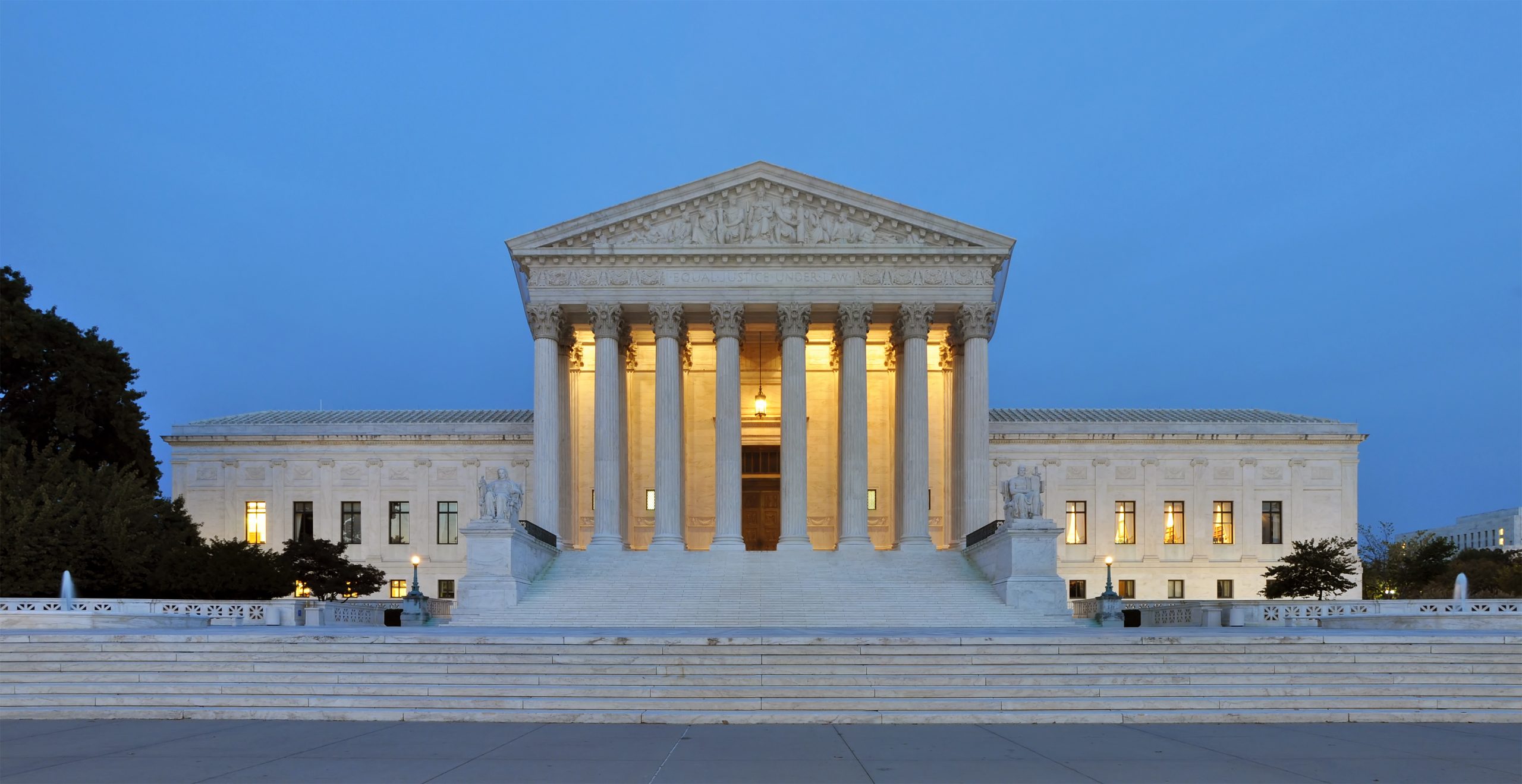

On Oct. 5, the United States Supreme Court officially began its 2026-2027 term. So far, the Court has agreed to hear around 30 cases — a lighter pace than its usual 60-80 cases heard per year.
Among these are disputes involving the First Amendment, the right to bear arms, immigration and climate change, as well as cases that could affect students’ voting rights, campus expression, financial lives and more. The cases below are standouts for their big-picture questions and potential implications.
1. Republican National Committee v. Mi Familia Vota
In Republican National Committee (RNC) v. Mi Familia Vota, the Supreme Court will consider whether the National Voter Registration Act (NVRA) – the law outlining voter registration procedures for federal elections – prevents Arizona from requiring proof of citizenship to register to vote.
In Arizona, voter registration applicants have to provide documents such as birth certificates, passports and driver’s licenses to prove their citizenship. The state adopted these requirements in 2022, directing counties to reject voter registration forms lacking citizenship documents. Counties also have to periodically check citizenship databases and cancel voter registrations of anyone confirmed to be a non-citizen.
Several plaintiffs, including the Democratic National Committee, challenged the requirement, arguing it violated various laws including the NVRA, the Civil Rights Act and the Equal Protection Clause. Lower federal courts previously ruled against Arizona, and the Supreme Court agreed to hear the dispute after an appeal.
If the Court rules in favor of the RNC and Arizona, states could have significantly more authority to require proof of citizenship when people register to vote using state forms. The case might further allow states to impose additional voting requirements beyond proof of citizenship.
The case also comes at a time when the SAVE Act, which would require proof of citizenship to register to vote at the federal level, rests in the Senate. These proposed voter registration rules create additional barriers to register to vote, which can especially impact eligible voters who move, attend school away from home or have difficulty obtaining documentation.
2. Department of Homeland Security v. D.V.D.
In Department of Homeland Security v. D.V.D., the Court considers whether the federal government can deport immigrants to countries other than their own – a practice known as “third-country removals.”
The dispute began following a January 2025 executive order, in which Trump authorized the Department of Homeland Security (DHS) to take “all appropriate actions” to remove noncitizens from the U.S. Since then, thousands have been deported to countries they have no established ties in, often without advance notice or an opportunity to raise concerns. The Court will evaluate whether this practice is unlawful under the Due Process clause, United Nations Convention Against Torture (CAT) regulations and other U.S. Statutes concerning deportation.
The case was first filed as a class-action lawsuit by a group of immigrant plaintiffs under the pseudonym D.V.D. Previously, a federal district judge restricted third-country removals under certain circumstances. The Supreme Court paused this order on request from the Department of Justice (DOJ) and allowed the removals to continue while the legal dispute proceeded. The Court is now hearing the case to uphold or overturn the federal district judge’s ruling.
The case concerns the limits of federal detention authorities and the legal protections people facing removal must receive. A ruling in favor of the government agencies would allow the Trump administration to continue deporting individuals to third countries as it has, while a ruling against the government could require stronger protections for those facing removal.
3. St. Mary Catholic Parish v. Roy
In St. Mary Catholic Parish v. Roy, the Court will decide whether Colorado must exempt Catholic schools from a nondiscrimination requirement in its publicly funded preschool program.
Colorado’s Universal Preschool Program provides free preschool services through participating preschool providers. To join, schools have to sign a nondiscrimination agreement which requires them to enroll students regardless of their or their family’s gender identity and sexual orientation. The Archdiocese of Denver and two Catholic parishes challenged this requirement, arguing that the nondiscrimination rule conflicts with their schools’ religious environments and allows the state to favor secular interests.
The Supreme Court will decide whether denying a religious exemption is against the Free Exercise clause of the First Amendment, which protects religious practice. While the case concerns preschools, its outcome could affect other publicly funded educational institutions, including colleges and campus organizations. A ruling in favor of the parish could mean states must make rule exemptions to provide religious schools or organizations with any government funds. The legal principles involved can also shape debates over protections for LGBTQ+ students and religious freedom.
4. Suncor Energy Inc. v. County Commissioners of Boulder County
In Suncor Energy Inc. v. County Commissioners of Boulder County, the Court will consider whether local governments can use state law to seek financial compensation from fossil fuel companies for climate-related damages.
Boulder County and the City of Boulder, Colorado sued ExxonMobil and Suncor Energy in 2018. They argued that the companies’ production and sale of fossil fuels contributed to climate change, causing harms including flood damages, wildfire risks, droughts and damage to public infrastructure. They also accused the companies of intentionally misleading the public about fossil fuels’ impact in accelerating climate change.
Boulder is seeking monetary damages rather than emissions regulations. Suncor and ExxonMobil argue that greenhouse gas emissions should be governed by federal law, not state law.
After extensive back-and-forth litigation, the case reached the Colorado Supreme Court in 2025. It ruled that federal law did not automatically block Boulder’s state law claims, and allowed the claims to proceed. The U.S. Supreme Court agreed to review the case and heard oral arguments on Oct. 5.
Climate change, drought, extreme heat, water infrastructure and public spending are important regional issues, especially in Nevada. The Court’s ruling could affect whether local governments across the country can pursue similar claims against oil and energy companies for climate-related damages.
5. Viramontes v. Cook County
In Viramontes v. Cook County, the Court is examining how the Second Amendment applies to state restrictions on certain semiautomatic rifles.
Cook County, Illinois enacted a law in 2013 banning the possession, sale and transfer of assault weapons, including semiautomatic rifles, AR-15 and AK-47 rifles. Under this law, anyone found to possess a banned rifle could face criminal penalties. Two county residents and two gun rights organizations sued Cook County on the grounds that the ban violated the constitutional right to bear arms.
Lower courts upheld the county’s ban. The Supreme Court agreed to hear oral argument on the case alongside a similar case, Grant v. Higgins.
The ruling could influence constitutional challenges to firearm restrictions in other states, including Nevada, and significantly shape broader debates about gun rights and public safety.
6. Rhoney v. Barbosa da Cunha
In Rhoney v. Barbosa da Cunha, the Court will decide whether the government can detain immigrants during their deportation proceedings without providing them with a bond hearing.
Last year, Immigrations and Customs Enforcement (ICE) reinterpreted a 1990s immigration law to implement a new policy that makes undocumented immigrants ineligible for release on bond, even if they have lived in the United States for years. As a result, tens of thousands of immigrants have been detained indefinitely by ICE, many of whom have filed lawsuits.
One of those immigrants, Ricardo Barbosa da Cunha, lived in the U.S. for more than 20 years, applied for asylum and obtained a work permit. Despite having no criminal conviction, DHS arrested him in September 2025 and detained him. A lower court ordered a bond hearing, after which an immigration judge released Barbosa da Cunha on bond.
The Supreme Court will now decide if the Trump administration can continue its practice of detaining immigrants without bond hearings. If the Court rules in favor of the Trump administration, it would also significantly limit immigration judges’ ability to release already-detained immigrants.
7. Crowther v. Board of Regents of the University System of Georgia
In Crowther v. Board of Regents of the University System of Georgia, the Court is evaluating whether Title IX allows employees of federally funded universities to sue for sex discrimination in employment.
The case concerns two former employees of Georgia universities. MaChelle Joseph, previously a Georgia Tech women’s basketball coach, complained her university provided inferior resources compared to the men’s basketball team. Shortly afterwards, the university hired an outside investigator to investigate Joseph’s conduct and fired her in 2019. Augusta University fired Thomas Crowther, a former art professor, in 2021 after an investigation into allegations that he had sexually harassed students. Crowther believed the investigation was unfairly conducted against him as a male respondent. Both Joseph and Crowther sued under Title IX, arguing that their firings were sex discrimination in employment.
The U.S. Court of Appeals for the Eleventh Circuit previously held that Title IX does not allow employees to sue for alleged sex discrimination in employment. The Supreme Court will either hold or overturn this ruling.
Crowther v. Board of Regents raises questions about fairness and how Title IX applies during universities’ disciplinary proceedings. The legal options available to challenge a university’s actions are currently limited. The Court’s ruling on this case will shape the legal boundaries surrounding university investigations, discrimination complaints, student safety and accountability.
The Court will hear oral arguments on these cases and others from October through April. After oral arguments conclude, the Justices will spend May and June releasing opinions and deciding remaining cases. Most decisions in argued cases are expected by the end of the term, June 2027.
Information about oral argument dates and case developments can be found on the Supreme Court’s official calendar and orders page.