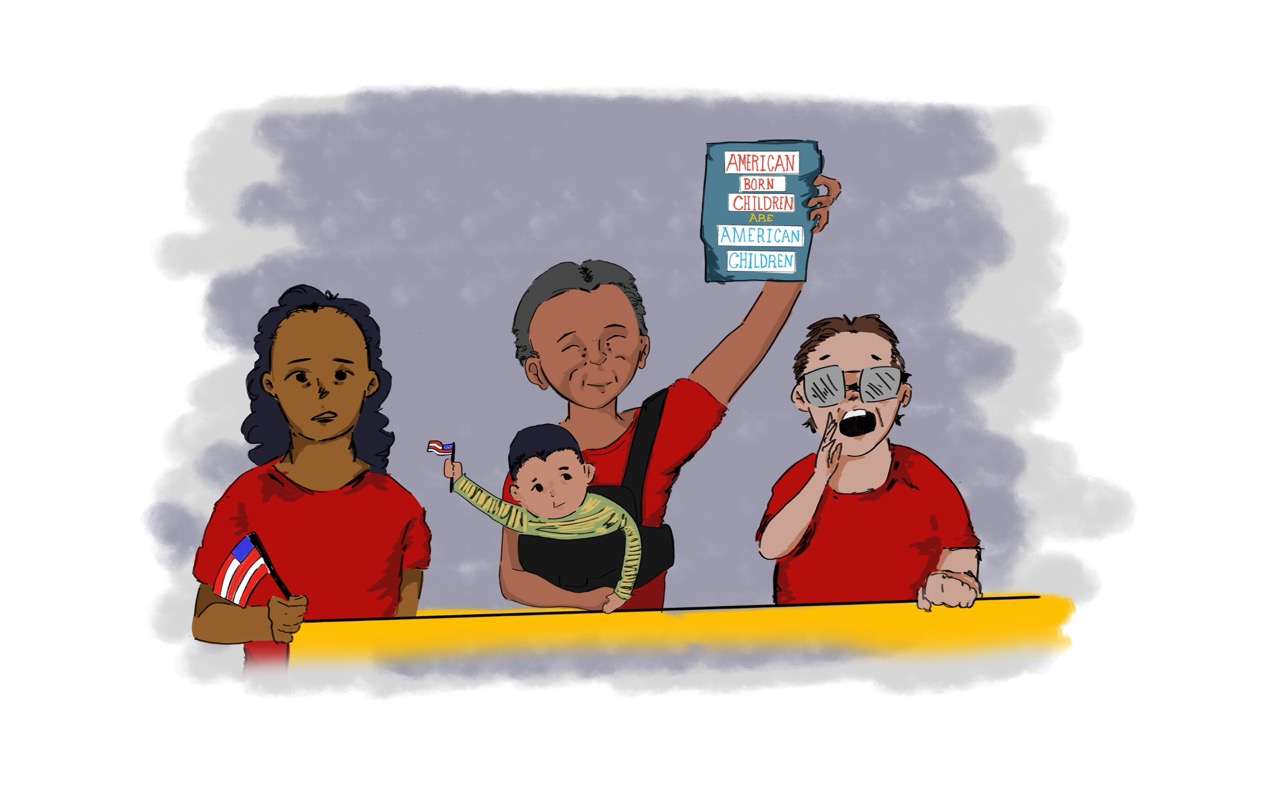

On June 30 in Trump v. Barbara, the U.S. Supreme Court rejected President Donald Trump’s attempt to end birthright citizenship in a 6-3 decision. This outcome dismissed Trump’s Executive Order 14156: Protecting the Meaning and Value of American Citizenship prohibiting the children of undocumented migrants and temporary visa holders from being U.S. citizens.

Oscar Lopez recently graduated from the University of Nevada, Reno with dual degrees in Spanish and Criminal Justice. He was born in the U.S. and is a child of immigrants. He said the Supreme Court’s decision felt bittersweet.
“That’s the bare minimum,” Lopez said. “Why, 250 years later, we’re still fighting about this — like you’re 250 years late, you’re still telling me, my people, my community, that we’re not American enough to you.”
Lopez’s parents immigrated from Cañada de Negros, Mexico in the early ‘90s. He said his parents had a very poor upbringing, and they moved to the U.S. to achieve the “American Dream,” hoping to improve their future and help the family they left behind.
He said he’s grateful for the opportunities he has because of the decision his parents made three decades ago. However, he said there has not been a day where he hasn’t felt fear for his parents’ safety since Trump took office.
“Not knowing if my mom is going to come home,” Lopez said. “I gave her the red cards, I would constantly quiz her on what her rights are or on what to do if she ever got pulled over. That’s a reality most people in this country don’t have.”
Both of Lopez’s parents are Green Card holders. However, his mother was undocumented until a couple of weeks ago when she passed her Green Card interview. If the Supreme Court had ruled in the opposite direction, Lopez’s citizenship status would have become uncertain.
Trump issued the executive order on his first day back in office on Jan. 20, 2025 as part of many measures he’s taken on immigration. The order received immediate legal challenges.
On the same day, immigrants’ rights advocates including American Civil Liberties Union (ACLU) sued the Trump administration over the order.
Cody Wofsy, deputy director of the ACLU’s Immigrants’ Rights Project said, “Denying citizenship to babies born on U.S. soil is illegal, profoundly cruel, and contrary to our values as a country.”
On behalf of several individuals who would have been impacted by the order, the ACLU and partners filed the class action lawsuit Trump v. Barbara.
Barbara is a pseudonym used to protect the lead plaintiff. She is a Honduran asylum-seeker who fled the Mara 18 gang with her husband and three children. She then became pregnant with her fourth in February 2025. Because of the order, she was fearful for her child’s future.
On April 1, 2026, Trump sat in the public section of the Supreme Court to hear the oral arguments regarding birthright citizenship. He was the first sitting U.S. president to attend oral arguments at the high court. He stayed for about an hour and a half and left after hearing his administration’s arguments and once the challengers, ACLU, began speaking.
Three months later, Supreme Court Justices Sonia Sotomayor, Elena Kagan, Amy Coney Barrett, Ketanji Brown Jackson, Brett M. Kavanaugh and Chief Justice John Roberts held that the order violates the 14th Amendment. This Amendment grants automatic U.S. citizenship to anyone born or naturalized in the U.S. Chief Justice Roberts said children born to parents who are in the U.S. unlawfully or temporarily are “born in the United States” and “subject to the jurisdiction thereof.”
Justices Clarence Thomas, Neil Gorsuch and Samuel Alito dissented from the majority ruling. Thomas wrote “The Citizenship Clause ‘added greatly to the dignity and glory of American citizenship.’” “Today’s opinion devalues that citizenship,” he added.
Michael Damien Aguirre, assistant professor of history at the University of Nevada, Reno, said the most important factor about the case is that it actually made it all the way to the Supreme Court.
“I encourage people to read what these justices wrote,” Aguirre said. “I think it’s really interesting to see the dynamic between Thomas and Brown Jackson and how different they were in terms of their opinions. It points to the fact that laws are made by people, interpreted by people and executed by people.”
Aguirre said he could only imagine the years of chaos that it would have caused if the ruling had gone the other way.
And for Lopez, he said the ongoing actions on immigration has made him more passionate.
“I think it’s made me hungrier. It gives me so much passion to continue down this road knowing I have an objective, and I have a passion for life that is bigger than myself,” Lopez said.
Lopez plans to become an immigration attorney to continue fighting and advocate for his people. He said he sees himself as a line of defense for his family.