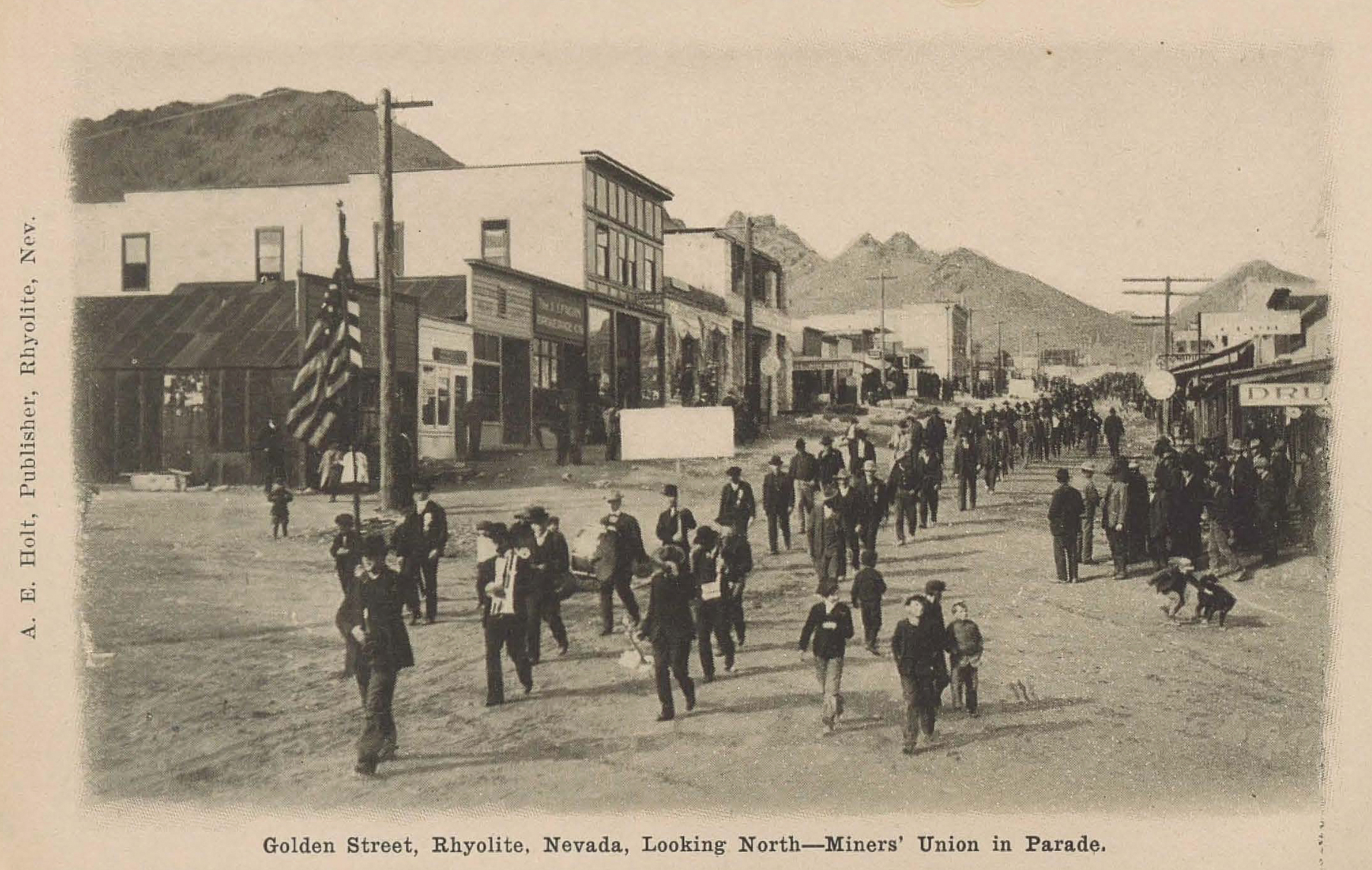

In the midst of one of the most heated primary cycles in recent memory, democratic socialism has built a strong base among the progressive wing of the Democratic party. But long before the left began to build a coalition through vibrant social media personalities, the West, particularly Nevada, served as one of the major hotbeds for these bold ideas in America.
Starting in the early 20th century, Nevada’s chapter of the Socialist Party became one of the most popular third parties in the country, even founding their very own socialist community in 1916 (Nevada City). The movement gained popularity first among mining communities in the western portion of the state. Places such as Fallon and other parts of Northern Nevada boasted a good portion of the party’s membership, though both Esmeralda and Nye counties accounted for some of the socialist support as well.
It has been speculated that the socialist momentum of the time was a side effect of the extremely popular progressive movement championed by President Theodore Roosevelt that subsequently lent the period its name: the Progressive Era. It is also important to note that while progressive politics were popular among both Democrats and Republicans, the Silver State’s socialist movement mostly drew votes from the Democratic coalition.
Nevada City, originally known as The Nevada Cooperative Colony, was first founded in 1916 four miles east of Fallon. Many of its original members included defectors from Fallon and other surrounding communities. Shortly after starting off strong with plans to build a sort of western utopia, the community began fizzling out following the murder of the Churchill County sheriff by one of its members.
The Silver State’s progressive history goes much deeper than one small town in its northern half. Voter sentiment for radical policies notably peaked in the 1912 and 1914 elections. In the 1912 cycle, Socialist Party presidential nominee Eugene V. Debs garnered 16.47% of the vote, outpacing incumbent President William Howard Taft. Debs ultimately fell short to both former President Theodore Roosevelt and Democratic nominee Woodrow Wilson, who won the state.
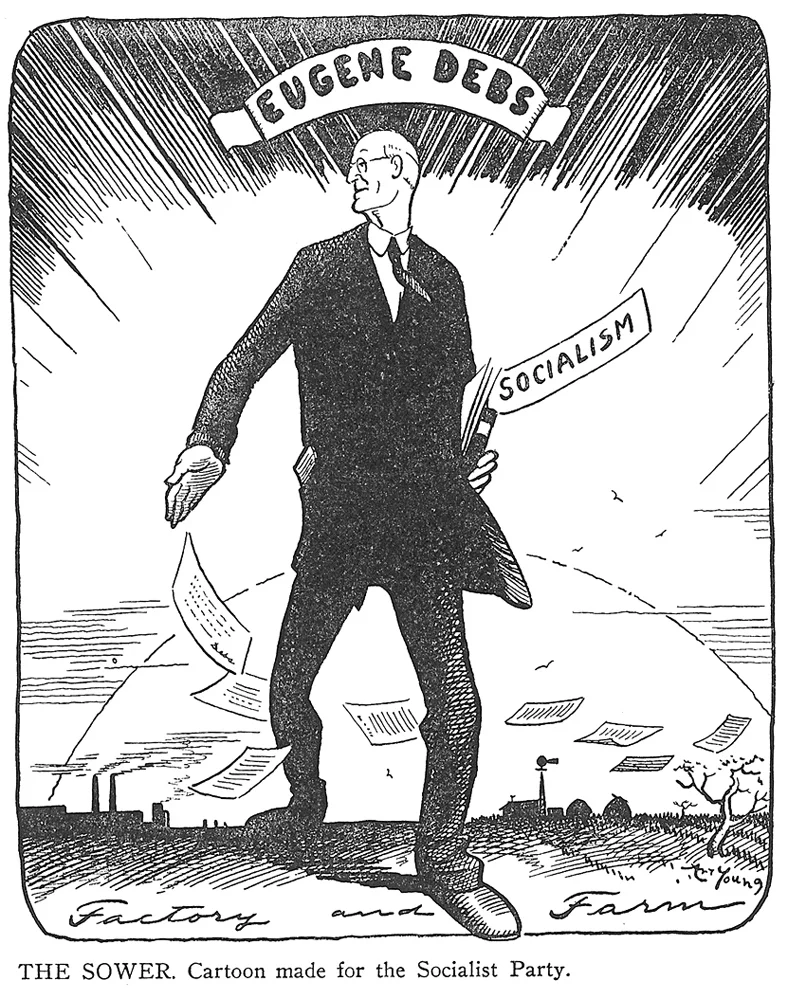
(Image drawn by Art Young for the Socialist Party cir. 1910)
The early years of the socialist movement focused mainly on economic issues, pushing public ownership of major industrial entities such as railroads and mines. It is this stance on industry that likely swayed a great number of mining communities in the West towards the party. The western mining industry, in particular, had an infamous reputation for extreme conditions and exploitative ownership. All of this culminated in the Goldfield, Nevada labor dispute of 1906 to1907 which resulted in President Roosevelt sending in federal troops at the request of Nevada Governor John Sparks to suppress a union strike.
Other policies at the forefront of the party’s platform included women’s suffrage, minimum wage requirements, and abolition of the electoral college in favor of a national popular vote.
In the wake of World War One’s outbreak, the Socialist Party’s message shifted towards isolationism and an anti-war stance ahead of the 1916 presidential election. The party famously campaigned for a policy that would require any declaration of war to rely on a direct popular vote of the people, instead of by Congress.
The midterm elections of 1914 saw the Socialist Party reign in more support; here the Socialists’ nominee for federal senate and house seats, as well as Nevada governor, won 25%, 20%, and 15% of the vote, respectively. Though none of these candidates won their races, three or more major candidates ran in each race, meaning that the winner on average only netted 40.9% of the total vote.
Following these elections, the national momentum in support of progressive politics started to cool. Socialist candidate for President Allan L. Berson only received 3.2% of the popular vote in 1916; Berson still accounted for 9.2% of the vote in Nevada. In that same election, President Wilson successfully secured reelection by winning 30 total states, including Nevada.
From there, the U.S. went on to elect three straight conservative Republican presidents in Warren G. Harding, Calvin Coolidge, and Herbert Hoover, effectively ending the socialist movement of the 1910s. Following Hoover, though, Democrat Franklin Delano Roosevelt was elected to four straight terms, all in landslide fashion. Roosevelt is considered one of the most progressive presidents in America’s history.
Since then, Nevada’s radical streak has certainly cooled, with its most notable traction coming in the 2021 election just five years ago. In this election, Democratic Socialist of America (DSA) candidates swept Nevada state leadership positions for the Democratic party. Their victory blindsided the Nevada Democratic establishment, which had long been characterized by the politics of the late Senator Harry Reid, who served as the Senate Majority Leader from 2007 to 2015.
Fast forward four years to today’s movement, notably led by New York City’s charismatic Mayor Zohran Mamdani. His platform’s popularity started to gain traction last summer once he won his party’s nomination by defeating former New York Governor Andrew Cuomo. Since then, a slew of DSA and progressive candidates have won Democratic primaries, even ousting longtime, entrenched incumbents in these races. These DSA-aligned candidates have begun to win outside of New York City as well. Melat Kiros, a 29 year old lawyer, defeated Dianna DeGette, a 15-term congresswoman representing Denver, Colorado, to seemingly reignite the western Socialist movement.
That same success has not appeared to have translated to Nevada, though, as it has in other places around the country and as it did in 2021. Here two DSA-endorsed candidates, Shaun Navarro and Val Thomason, both running for Nevada Assembly, lost their respective primary races by wide margins.
While Democratic Socialists’ popularity continues to grow as the midterms draw near, a glimpse at Nevada’s radically progressive past can provide necessary insight into a movement that has long been dormant in America.